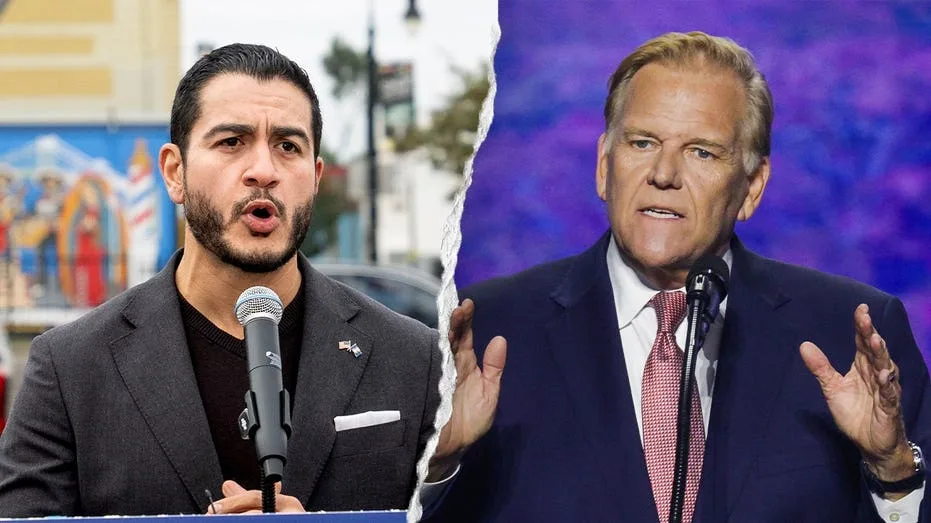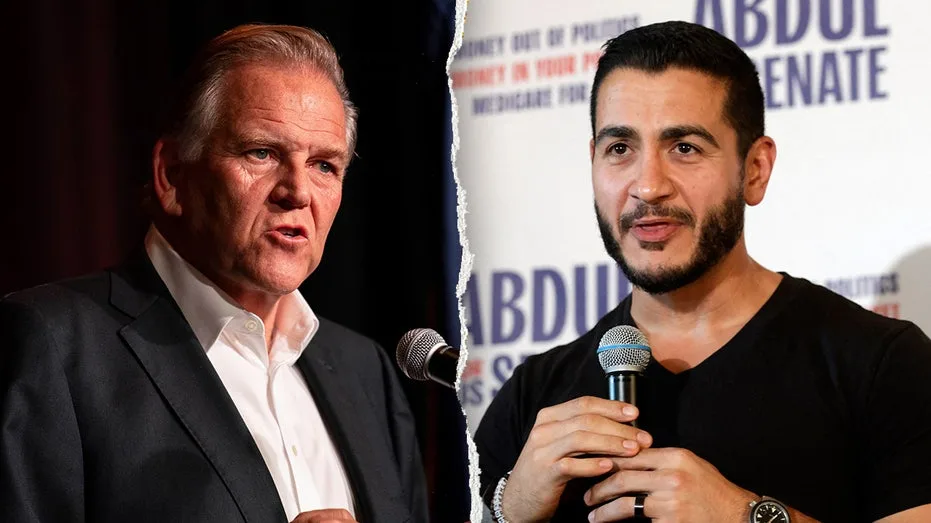
The recent U.S. Senate debate in Michigan saw former President Donald Trump emerge as a prominent, albeit unofficial, figure, as Democratic candidate Abdul El-Sayed sought to portray his Republican opponent, Mike Rogers, as closely aligned with Trump's agenda. Despite El-Sayed's persistent efforts to link him to the former president, Rogers demonstrated several policy divergences, particularly concerning trade practices.
Trump's Pervasive Presence
Throughout the hour-long discussion, El-Sayed invoked Trump's name 18 times, frequently labeling Rogers' responses as "MAGA bingo," suggesting they were merely echoes of Trump's established talking points. This phrase became a recurring motif, with El-Sayed deploying it after Rogers accused him of advocating for socialist policies, open borders, and defunding law enforcement agencies. Rogers eventually redirected the criticism, quipping that the true "bingo game" was how often El-Sayed brought up the former president in his own answers.
Rogers' Policy Divergences
Despite El-Sayed's persistent efforts to link him to Trump, Rogers demonstrated several instances of policy divergence, particularly concerning international trade. He described the former president's tariffs as a "mixed bag" and suggested that tariffs imposed on Canada "may have been not well thought through."
Rogers also expressed strong opposition to Chinese automotive manufacturers establishing production facilities within the United States. During the debate, he advocated for congressional action to prohibit Chinese companies from building cars domestically. El-Sayed quickly highlighted that Trump had previously indicated an openness to such a development, questioning whether Rogers would truly challenge the former president on this specific issue.
High Stakes and Heated Exchanges
Wednesday evening marked the second face-off between El-Sayed and Rogers, occurring just weeks ahead of Michigan's crucial midterm election. The contest for the state's open Senate seat has garnered national attention, not only for its potential impact on the balance of power in the upper chamber but also as a significant indicator of the Democratic Party's progressive strength in a key battleground state.
El-Sayed, who has received endorsements from prominent progressive figures like Senator Bernie Sanders (I-Vt.) and Representative Alexandria Ocasio-Cortez (D-N.Y.), has built his campaign on an agenda that includes universal healthcare access through Medicare for All, increased taxation on wealthy individuals, ending U.S. military aid to Israel, and dismantling Immigration and Customs Enforcement (ICE). While El-Sayed aimed to characterize Rogers as a "corporate politician" aligned with Trump, Rogers consistently accused his Democratic rival of a "pattern of deception," alleging that El-Sayed had misrepresented his own record and shifted his policy stances.
Throughout the debate, Rogers positioned El-Sayed as outside the political mainstream, connecting his opponent and his proposed policies to the Democratic Socialists of America. He also repeatedly criticized El-Sayed's past advocacy for defunding police departments.
Allegations and Allegiance
The debate grew particularly contentious when Rogers made claims regarding El-Sayed's financial supporters, alleging connections to groups such as Hamas, Hezbollah, and the Muslim Brotherhood. At one point, Rogers directly challenged El-Sayed's loyalty to the nation, asking, "Are you for America or are you for these terrorist groups overseas?"
The most heated exchange occurred during a segment on public safety. Rogers pressed El-Sayed on his previous support for defunding the police, accused him of deleting social media posts related to the issue, and referenced El-Sayed's past comments concerning former Egyptian President Mohamed Morsi, who was supported by the Muslim Brotherhood.
El-Sayed vehemently rejected these insinuations, stating it was "beneath" Rogers to question his dedication to the Constitution. He declared his pride in being an American and condemned Rogers' line of questioning as "shameful."
El-Sayed, a Muslim and a first-generation American whose parents immigrated from Egypt, has faced considerable scrutiny over his remarks concerning the conflict in Gaza and his positions on Israel. This has led some within Michigan's Jewish community to publicly distance themselves from the Democratic candidate. Rogers asserted during the debate that his campaign was resonating well with the Jewish community, which he claimed was apprehensive about El-Sayed's rhetoric.
Rogers concluded that El-Sayed's views were too "extreme" for Michigan, citing prominent Democrats who have indicated they cannot endorse their party's nominee, including a former Michigan Democratic Party chairman and the former finance chair for Senator Elissa Slotkin's campaign.
Michigan Republicans echoed this sentiment post-debate. MIGOP Chairman Jim Runestad issued a statement, highlighting El-Sayed's past association with Twitch streamer Hasan Piker, who once controversially remarked that America deserved the September 11 terrorist attacks. Runestad stated, "We cannot afford Abdul El-Sayed's far-left, big-government policies, and we cannot risk electing a person who campaigns with the likes of Hasan Piker and seemingly justified the horrific terrorist attack targeting children and the Jewish community in Bloomfield Hills."